|
SmartWORKS™ IPX Series
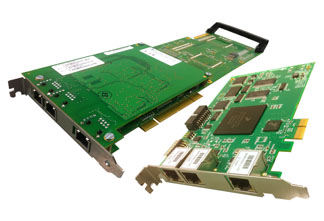 |
The SmartWORKS IPX is an essential component of your call recording solution that provides packet filtering and media forwarding for IP-PBXs. It has one on-board connection for forwarding up to 960 RTP streams and two on-board connections for monitoring the IP traffic at the wire speed. When combined with the HPXMedia, the IPX provides complete event triggering, call state reporting and media processing for many of the industry leading IP-PBXs. |
| |
Key Features and Benefits:
- Universal PCI & PCI Express
- Two 100/10 BT ports for non-intrusive
monitoring
- One 100/10 BaseT active NIC
- Forwards VoIP RTP sessions to one or
more network devices
- Processes all VoIP call and terminal control
signaling
- SmartWORKS API
(Common to all SmartWORKS boards)
- Field upgradeable
- Low to high density - call capacity to monitor up to 480 active VoIP endpoints. Limited by license
- RTP timeout & RTCP Qos
- Available for Windows 2000, XP, Windows
2003 server, windows2008 server, windows7,
Windows8 Server
-
Multiple PBX Support – The same hardware supports multiple protocols including Skinny and Avaya and is designed to accommodate future protocols such as SIP and H.323 with just a software upgrade.
-
Multiple Protocol Support – The same hardware supports SIP, H.323 and Skinny (SCCP) etc. and is designed to accommodate future protocols with just a software upgrade.
-
Flexible Event Triggering – Applications can start and stop recording based on AudioCodes call control or take advantage of PBX/protocol specific messages.
-
Tap Environment – The IPX is designed for IP call recording applications. It’s active interfaces can be connected
directly to an available mirror port or, when used in conjunction with a TX100/TX1000, can be
connected passively anywhere within the IP-PBX configuration.
Up to 480 media sessions per board can be monitored at a time.
-
Session Management – The IPX software includes a Session Manager for tracking media sessions on the IP network.
Each media session is treated as a unique call with a unique Session ID.
Your application can easily manage media forwarding with the Session IDs provided by the IPX.
-
Station Management – Automatically locates all VoIP endpoints on the network and assigns each a unique Station ID.
IPX software dynamically identifies phones as they are added to the network and reports when
they are removed.
-
RTP Timeout & RTCP QoS – IPX detect the RTP timeout, when exceed the time set in the SmartControl, the IPX regard this
call is already ended and report the ““EVT_MEDIA_SESSION_STOPPED” to user application.
This feature can avoid the recording problem due to lost packets.
|
| |
| |
*
All document will in Portable Document Format (PDF).
For Enquiry, please contact: sales@icg-corp.com
|
|
|